

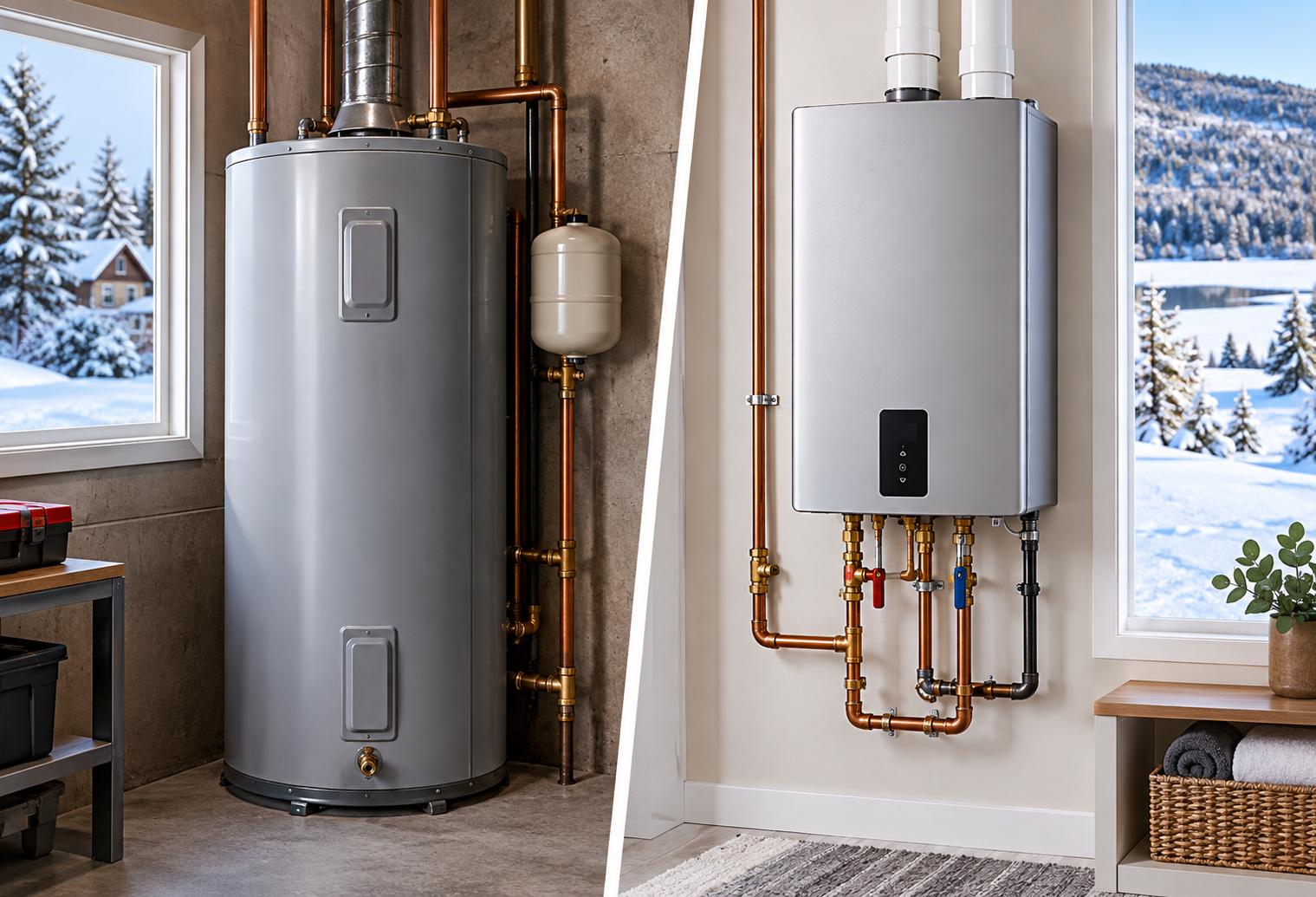
Choosing between a traditional tank water heater and a tankless water heater in Cadillac is not simply a matter of deciding which system is newer. Northern Michigan winters, household size, hot-water habits, existing gas or electrical infrastructure, installation costs, and the condition of your home’s plumbing can all influence which option makes the most sense.
Quick answer: A traditional tank water heater is often the more straightforward and budget-friendly choice for Cadillac homeowners who want dependable hot water with a familiar installation. A tankless water heater can be worth the additional upfront investment for households that value longer equipment life, reduced standby energy use, and hot water that does not depend on the capacity of a storage tank. However, cold incoming water during Cadillac winters can increase the workload placed on a tankless system, making proper sizing especially important.
What Cadillac homeowners should know
-
Tank water heaters store a set amount of heated water and keep it ready for household use.
-
Tankless water heaters heat water as it flows through the unit rather than storing it in a large tank.
-
Cadillac’s cold winter groundwater temperatures can affect how much hot water a tankless unit can produce at one time.
-
Household size and simultaneous hot-water demand matter when sizing either type of system.
-
Switching from a tank to a tankless water heater may require changes to gas lines, venting, electrical service, or other components.
-
The least expensive water heater to purchase is not necessarily the least expensive option over its entire service life.
-
Fresh Coast Plumbing Co provides water heater installation and plumbing services for homeowners throughout the Cadillac area.
Is a Tank or Tankless Water Heater Better for Cadillac Homes?
The better choice depends on your home’s existing setup, the amount of hot water your household uses, your budget, and what you expect from the system over the long term. Both tank and tankless water heaters can work well in Cadillac when they are properly selected and installed.
For a smaller household that uses hot water at different times of the day, a properly sized tankless system may provide plenty of capacity without continuously storing heated water. Meanwhile, a busy family running showers, laundry, and the dishwasher around the same time may need a carefully sized tankless unit or may find that a traditional tank provides a simpler solution.
Existing plumbing infrastructure also matters. Replacing one conventional tank water heater with another is generally more straightforward than converting an existing home to tankless. Before making the decision, Fresh Coast Plumbing Co looks at the whole installation rather than focusing only on the equipment itself.
How Do Tank and Tankless Water Heaters Compare?
Traditional tank water heaters and tankless water heaters accomplish the same basic job in different ways. A tank system heats and stores water for later use, while a tankless unit heats water only when a fixture or appliance calls for it.
Traditional Tank Water Heaters
A traditional water heater stores hot water inside an insulated tank. Common residential sizes are designed to keep a certain volume of heated water available for showers, sinks, washing machines, dishwashers, and other household needs.
Tank water heaters are familiar to most homeowners and generally involve a more straightforward replacement when the new system is similar to the existing one.
However, the household can temporarily run out of hot water if demand exceeds the tank’s capacity. Once that happens, the unit needs time to heat another supply.
Tankless Water Heaters
A tankless water heater does not maintain a large reservoir of heated water. Instead, water moves through the unit and is heated when someone opens a hot-water fixture.
That eliminates the traditional issue of emptying a storage tank. However, tankless systems still have capacity limits. Their performance is measured partly by how much water they can heat to the desired temperature at a given flow rate.
That distinction is particularly important during Cadillac winters.
Why Do Cadillac Winters Matter When Choosing a Water Heater?
Cadillac winters matter because the colder the incoming water is, the more energy a water heater needs to raise it to a comfortable household temperature. This is especially important when sizing a tankless water heater.
Imagine that the water entering a Cadillac home during winter is significantly colder than it is during warmer months. A tankless unit must raise that cold water to the desired temperature while the water is moving through the system.
The greater the required temperature increase, the less hot-water flow a particular tankless unit may be able to support simultaneously.
A system that appears more than capable based on warmer-weather conditions may perform differently during the coldest part of a Northern Michigan winter. That is why tankless water heater sizing should reflect local conditions instead of relying only on general product claims.
Traditional tank water heaters are affected by colder incoming water as well, but their stored supply changes how homeowners experience that demand.
How Does Household Hot-Water Demand Affect the Decision?
Your peak hot-water demand is one of the most important factors when choosing between a tank and tankless water heater. The question is not simply how many gallons of water your household uses during an entire day. What matters is how much hot water you may need at the same time.
Consider a household where one person showers while the dishwasher runs and someone else uses hot water at the kitchen sink. Those fixtures create simultaneous demand.
With a tank water heater, the stored volume helps accommodate that demand until the available hot water is depleted.
With a tankless system, the unit has to heat the total flow passing through it in real time.
Therefore, homeowners considering tankless water heater installation should think about actual household routines rather than choosing equipment solely from the number of people living in the home.
What Installation Differences Should Cadillac Homeowners Expect?
Installing a tank water heater is often more straightforward when it replaces a similar existing unit, while converting to tankless can require additional plumbing, venting, gas, or electrical work. The exact requirements depend on the home and the equipment being installed.
A tankless water heater may require:
-
Different gas-line capacity.
-
Updated venting.
-
Electrical connections.
-
Changes to water piping.
-
Condensate drainage on certain units.
-
A different mounting location.
-
Additional space around the equipment for service access.
These are not reasons to avoid tankless systems. They are reasons to evaluate the complete project before comparing prices.
A homeowner may see the price of a tankless unit online and assume that represents the entire cost of switching systems. In reality, installation conditions can make a substantial difference.
What Are the Advantages of a Traditional Tank Water Heater?
Traditional tank water heaters remain popular because they are familiar, relatively simple, and often less expensive to install than a tankless conversion.
For many Cadillac homeowners, that simplicity is a major advantage.
A tank water heater may be a good fit when:
-
The existing system is already a tank model.
-
The household is satisfied with its current hot-water capacity.
-
Upfront project cost is a major consideration.
-
The home does not need the space currently occupied by the tank.
-
The homeowner prefers a straightforward replacement.
Tank systems also provide a reserve of heated water. However, once that stored supply has been used, the household has to wait while additional water heats.
What Are the Advantages of a Tankless Water Heater?
Tankless water heaters appeal to homeowners who want on-demand water heating, reduced standby heat loss, a smaller equipment footprint, and potentially longer equipment life when the system is properly maintained.
Because a tankless unit does not continually maintain a large volume of hot water, it avoids some of the standby energy losses associated with storage tanks.
Tankless units also take up considerably less space than conventional tanks.
Another attraction is the ability to continue producing hot water without being limited to a 40-, 50-, or other gallon storage capacity. Still, “endless hot water” does not mean unlimited simultaneous flow. The unit must be sized to handle the amount of water the household wants heated at once, particularly during cold Cadillac winters.
Is Tankless Always More Energy Efficient?
Tankless water heaters can reduce energy used to keep stored water hot, but actual household energy savings depend on water usage, equipment efficiency, fuel type, installation, and operating habits. Homeowners should be cautious about assuming that switching to tankless automatically produces a specific dollar amount of savings.
A household that uses relatively little hot water may experience different results than a large family with heavy daily demand.
The cost of converting the home’s infrastructure should also be considered when evaluating the financial side of the decision.
For some homeowners, efficiency is the primary reason to choose tankless. For others, equipment longevity, space savings, or hot-water availability may matter more.
What Local Conditions Can Affect Water Heater Replacement?
The condition of the home’s existing plumbing, gas supply, venting, electrical system, shutoff valves, and installation area can all affect a water heater replacement.
Cadillac and Wexford County contain homes from many different eras. Some properties have newer mechanical systems, while others have been remodeled several times or still contain portions of older plumbing.
A water heater replacement may reveal:
-
Aging shutoff valves.
-
Corroded connections.
-
Older piping.
-
Venting that needs attention.
-
Insufficient gas-line capacity for a proposed tankless system.
-
Limited installation clearance.
-
Previous plumbing modifications.
Those conditions should be identified before selecting equipment whenever possible.
Kyle Blevins, local owner-plumber of Fresh Coast Plumbing Co, helps Cadillac homeowners evaluate the installation itself as well as the water heater being considered.
What Warning Signs Suggest Your Water Heater Needs Attention?
A water heater should be evaluated when hot-water performance changes, leakage appears around the equipment, unusual operating behavior develops, or the system no longer reliably meets household needs.
Watch for:
-
Water collecting around the water heater.
-
Hot water running out significantly faster than it previously did.
-
Water that does not reach the expected temperature.
-
Unusual noises from a tank water heater.
-
Visible corrosion around connections.
-
Recurring error codes on a tankless system.
-
Fluctuating hot-water temperatures.
-
Changes in water appearance or odor that appear connected to the hot-water system.
-
A system that repeatedly shuts down or fails to produce hot water.
Water around the base of a tank should not be ignored. The source could involve a connection, valve, or the tank itself, and determining where the leak originates is important.
When Should You Call a Plumber for a Water Heater?
Call a plumber when the water heater is leaking, producing unreliable hot water, showing signs of deterioration, or when you are considering replacing or converting the system.
Homeowners can observe symptoms and gather information about their existing equipment, but water heater installation involves more than disconnecting one appliance and connecting another.
Gas, electrical, venting, water-pressure, and plumbing requirements all need to be addressed correctly.
Professional evaluation is particularly useful when you are deciding whether to replace a tank with another tank or invest in a tankless conversion. Understanding what your house actually requires makes the comparison much more meaningful.
What Common Mistakes Should You Avoid When Choosing a Water Heater?
The biggest mistakes are choosing based solely on equipment price, assuming tankless automatically means unlimited hot water, and failing to consider the infrastructure required for installation.
Mistake: Buying based only on gallon capacity.
Consequence: The water heater may not match the household’s actual usage pattern.
Better approach: Consider both household size and peak hot-water demand.
Mistake: Assuming any tankless unit can handle multiple fixtures at once.
Consequence: Hot-water performance may disappoint during periods of heavy demand.
Better approach: Size the system using expected flow rates and Cadillac’s colder incoming winter water.
Mistake: Comparing equipment prices without installation costs.
Consequence: A tankless conversion may cost more than expected once necessary plumbing, gas, venting, or electrical work is included.
Better approach: Compare the complete installed project.
Mistake: Waiting until the current water heater fails completely.
Consequence: You may have to make a rushed replacement decision without time to compare options.
Better approach: If an aging water heater is showing warning signs, begin discussing replacement choices before an emergency occurs.
Should You Replace a Tank Water Heater With Tankless During a Remodel?
A kitchen, bathroom, or larger home remodel can be a practical time to discuss water heater changes because other plumbing work may already be taking place.
Planning ahead matters.
Fresh Coast Plumbing Co handles plumbing for remodeling projects as well as water heater installation. If a remodel includes significant plumbing changes, homeowners should discuss water heater plans with their plumber before cabinetry, walls, and other finished components make access more difficult.
The same principle applies throughout a remodel: plumbing decisions are easier to address before everything is closed up and finished.
If you are already considering a tankless conversion, bringing that idea into the planning process early gives the plumber an opportunity to evaluate gas, water, venting, and electrical requirements before the project advances.
What Maintenance Do Tank and Tankless Water Heaters Need?
Both tank and tankless water heaters benefit from proper maintenance, although their service needs are different.
Traditional tank water heaters can accumulate sediment over time. Valves, connections, and other components also deserve periodic attention.
Tankless systems contain heat exchangers and other internal components that may require manufacturer-specified maintenance. Water quality, usage, and equipment design can influence service requirements.
Homeowners should follow the maintenance recommendations provided for their specific system rather than assuming all water heaters follow the same schedule.
Regular attention also gives homeowners a better opportunity to identify leakage or performance changes before they become larger problems.
What Results Should You Expect From a New Water Heater?
A properly selected and installed water heater should provide dependable hot water within the operating limits of the specific system.
A correctly sized tank should provide storage capacity appropriate for the household’s expected needs.
A properly sized tankless system should produce hot water at flow rates that reflect the unit’s capabilities and the temperature of incoming water.
However, replacing a water heater will not correct unrelated plumbing problems elsewhere in the house. Low water pressure, fixture problems, pipe restrictions, or other plumbing conditions may need separate attention.
Understanding that distinction helps homeowners set realistic expectations for the upgrade.
What Is a Common Water Heater Replacement Scenario in Cadillac?
A common Cadillac scenario involves a homeowner with an aging tank water heater who is deciding whether to install another conventional tank or use the replacement as an opportunity to switch to tankless. This is a representative local example rather than a specific Fresh Coast Plumbing Co customer case study.
Suppose a Cadillac family has a traditional tank water heater that still operates but no longer keeps up as well during busy mornings. They are attracted to tankless technology because they want longer showers without worrying about completely draining a storage tank.
Before converting, the home’s gas supply and venting need to be evaluated. The household also regularly uses multiple hot-water fixtures at once.
In that situation, the question is no longer simply whether tankless is “better.” The decision depends on how much hot water the household needs simultaneously, how the unit will perform with cold winter inlet temperatures, and what modifications the home requires.
That is the kind of comparison homeowners should make before purchasing equipment.
Is a Tankless Water Heater Worth the Extra Cost?
A tankless water heater can be worth the additional upfront investment when its operating characteristics, space savings, expected service life, and hot-water capabilities align with the household’s priorities.
However, tankless is not automatically the best financial decision for every Cadillac homeowner.
If a conventional tank already serves the household well and replacing it requires minimal changes, another tank water heater may offer excellent value.
On the other hand, a homeowner planning to remain in the house for many years may place greater value on the potential long-term advantages of tankless equipment.
The right comparison includes both upfront installation costs and how you expect to use the system over time.
Which Plumbing Services Support a Water Heater Upgrade?
Professional plumbing services can help evaluate existing connections, water lines, gas supply, valves, venting requirements, and other conditions associated with a water heater installation.
Fresh Coast Plumbing Co works with Cadillac homeowners on water heater projects as well as plumbing for kitchen remodels and other residential improvements.
If your remodel includes a new water heater, bring that decision into the conversation early. Plumbing requirements are much easier to accommodate before cabinets, walls, and finished surfaces restrict access.
Fresh Coast Plumbing Co is locally owned by Kyle Blevins and provides licensed and insured plumbing services in the Cadillac area.
[CTA: Call Fresh Coast Plumbing Co at (231) 429-3264 to discuss your water heater options.]
Where Does Fresh Coast Plumbing Co Serve?
Fresh Coast Plumbing Co provides residential plumbing services in Cadillac, MI, and surrounding areas. Homeowners throughout the Cadillac and Wexford County area can contact us to discuss water heater replacement, installation, remodeling plumbing, and other residential plumbing needs.
For availability at a specific property outside Cadillac, contact our team directly.
What Can Happen If You Put Off Water Heater Replacement?
Waiting too long to address an aging or deteriorating water heater can turn a planned home improvement into an urgent plumbing problem.
Not every older water heater is about to fail, and age alone does not determine the condition of the equipment. However, recurring hot-water problems, corrosion, leakage, and declining performance deserve attention.
Planning ahead gives you more time to compare tank and tankless options, understand installation requirements, and choose equipment based on your household rather than making a rushed decision because hot water has suddenly disappeared.
[CTA: Call (231) 429-3264 if your water heater is leaking, struggling to keep up, or ready for replacement.]
FAQ About Tank and Tankless Water Heaters in Cadillac
Is tankless better than a tank water heater in Cadillac?
Tankless is not automatically better for every Cadillac home. It can provide advantages such as reduced standby energy use, compact installation, and continuous water heating within the unit’s flow capacity. Traditional tank systems remain a practical choice for homeowners who prioritize lower upfront installation costs and straightforward replacement.
Do tankless water heaters work during Michigan winters?
Yes, properly selected tankless water heaters can operate during Michigan winters, but cold incoming water makes correct sizing particularly important. The unit must produce enough temperature rise while maintaining the flow rate required by the household. A system should be selected with winter conditions in mind rather than based only on warmer inlet-water temperatures.
Can a tankless water heater run two showers at once?
A tankless water heater can serve multiple fixtures when the combined flow stays within the unit’s heating capacity. Whether a specific system can comfortably supply two showers, a sink, or an appliance simultaneously depends on the equipment, incoming water temperature, desired outlet temperature, and fixture flow rates.
Will I save money by switching to tankless?
A tankless system may reduce standby energy use, but the financial outcome depends on equipment efficiency, household water usage, fuel costs, installation requirements, and how long you keep the system. Cadillac homeowners should compare the complete cost of ownership rather than assuming a particular amount of savings.
Is it expensive to convert from a tank water heater to tankless?
A tankless conversion can cost more than a straightforward tank replacement because the home may require gas-line, venting, electrical, or plumbing modifications. The amount of additional work varies considerably from one property to another, so an evaluation of the existing setup is important.
How do I know what size water heater I need?
Water heater sizing depends on household demand rather than square footage alone. Tank systems are commonly evaluated based on storage capacity and recovery performance, while tankless units require consideration of simultaneous flow and temperature rise. Cadillac’s cold winter inlet-water temperatures should be included when sizing a tankless system.
Should I replace my water heater before it fails?
Planning replacement before a failing water heater becomes an emergency gives you more time to compare equipment and installation options. Leakage, corrosion, recurring performance problems, and declining hot-water capacity are good reasons to have the system evaluated.
Who installs water heaters in Cadillac, MI?
Fresh Coast Plumbing Co provides water heater and residential plumbing services for homeowners in the Cadillac area. Local owner-plumber Kyle Blevins can evaluate the existing setup, discuss tank and tankless options, and determine what the installation requires.
Choose a Water Heater That Fits Your Cadillac Home
There is no universal winner in the tank versus tankless debate. For some Cadillac homeowners, replacing an existing storage water heater with another dependable tank system offers the right balance of cost, capacity, and simplicity. For others, the smaller footprint, operating characteristics, and long-term advantages of a properly sized tankless system make the additional investment worthwhile. Northern Michigan winters make thoughtful sizing especially important because incoming water can be considerably colder when demand for hot water is often at its highest. Instead of choosing based on advertising claims alone, consider your household’s routines, existing plumbing, budget, and long-term plans for the home.
Get Straight Answers About Your Cadillac Water Heater Options
If your current water heater is aging, leaking, struggling to keep up, or simply no longer fits the way your household uses hot water, Fresh Coast Plumbing Co can help you compare your options without treating one system as the automatic answer. Kyle Blevins brings local plumbing experience to homes throughout the Cadillac area and can evaluate the equipment as well as the plumbing, gas, venting, and other conditions surrounding the installation. Whether another tank makes the most sense or you are considering a tankless conversion, planning the project around your actual home is the best place to start. Call Fresh Coast Plumbing Co at (231) 429-3264 to discuss water heater installation in Cadillac, MI.
[CALL NOW] [CONTACT FRESH COAST PLUMBING CO]